Will Dental Implants Affect MRI? Safety and Image Quality
Will dental implants affect MRI? Learn how titanium implants affect MRI safety, image quality, and what to tell your imaging team before a scan.
You have dental implants, and now your doctor wants you to have an MRI.
Naturally, you may wonder whether the metal in your mouth could cause problems inside the scanner.
You might even worry that the powerful magnet could pull on your teeth.
Fortunately, most people with dental implants can have an MRI safely, provided the imaging team confirms that their specific dental devices are suitable.
However, the materials used and the part of your body being scanned can affect the results. For example, an implant may cause image distortion during a scan of your jaw but have little effect on an MRI of your knee.
The FDA’s guidance on dental implants explains that implants use different materials, including titanium and zirconium oxide.
If you have dental implants, knowing what to expect can help you prepare for your scan and avoid unnecessary worry.
Will Dental Implants Affect MRI Safety?
In most cases, dental implants do not prevent you from having an MRI.
Many implants use titanium or titanium alloys, which are not strongly attracted to magnetic fields.
However, you should never assume that every dental device is safe under all MRI conditions. Safety depends on the exact device, its materials, and the scanner being used.
Before your scan, tell the MRI team if you have:
- Dental implants or implant-supported dentures.
- Magnetic attachments used to hold dentures in place.
- Braces or other dental appliances.
- Other medical implants or devices.
The RadiologyInfo MRI safety guide explains why medical staff must screen patients for implants and other objects before an MRI.
Can Dental Implants Move During an MRI?
A properly placed titanium dental implant is generally not expected to move during an MRI. It is designed to remain fixed in your jawbone.
However, other dental devices may behave differently. For example, some removable dentures use magnetic attachments. These require extra checks because their magnetic properties may affect MRI safety.
A study published in the National Library of Medicine examined how magnetic dental attachments interact with MRI systems.
If your dental appliance contains magnets, tell the MRI team before entering the scanner. Do not remove or alter any fixed dental device yourself.
Can Dental Implants Distort MRI Images?
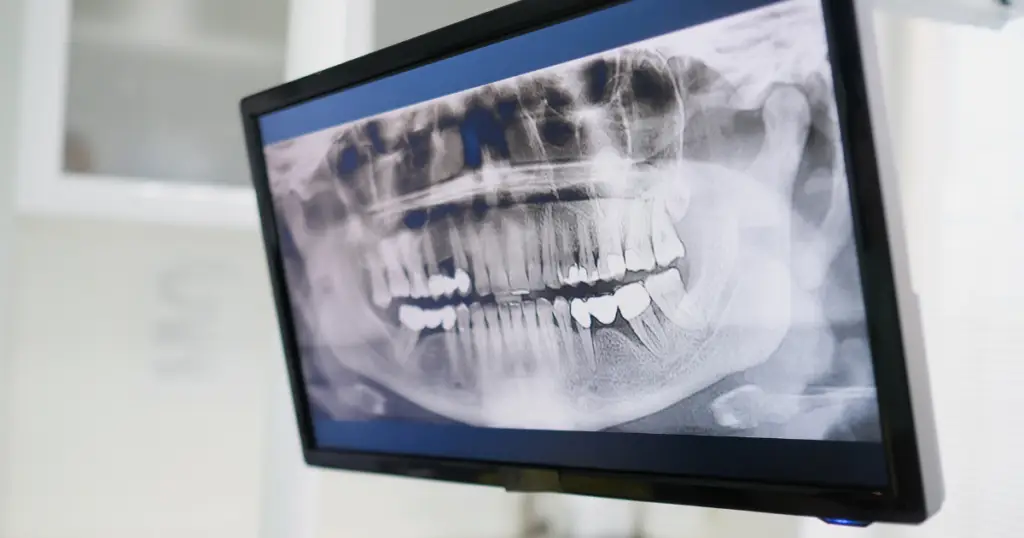
Yes. Image distortion is often a bigger concern than implant movement.
MRI machines create detailed images using magnetic fields and radio waves. Metal can disturb the signals used to create these images. This may cause dark areas, warped shapes, or missing details around an implant. These problems are known as artifacts.
The effect depends on several factors:
- Implant material: Different metals produce different levels of distortion.
- Implant location: Implants near the area being scanned are more likely to affect image quality.
- Scanner settings: The MRI team may adjust the imaging method to reduce artifacts.
- Implant size and design: These can affect how much of the image becomes distorted.
For example, a dental implant may affect an MRI of your jaw or face more than a scan of your knee. Your radiologist can decide whether the distortion affects the information needed for your diagnosis.
Research published in Clinical and Experimental Dental Research reviews how dental materials can affect MRI image quality.
What Happens If You Have Titanium Dental Implants?
Titanium is widely used for dental implants because it is strong and works well with the body.
So, will dental implants affect MRI if they contain titanium? They can affect image quality, but that does not automatically make the scan unsafe.
Titanium may cause some signal loss around the implant, especially when the scanner is examining nearby tissues. The amount of distortion depends on the implant and the imaging method.
Your radiologist may change certain scan settings to reduce these effects. However, some distortion may remain, particularly when examining the mouth, jaw, or nearby structures.
The important point is that titanium implants do not automatically make MRI images unusable. Your imaging team must assess the specific scan and its purpose.
Can You Have a Brain MRI With Dental Implants?
Usually, yes, provided the MRI team confirms that your implants are safe for the planned scan.
Dental implants can distort images around the mouth and jaw. Depending on their position and the scan settings, this distortion may affect nearby areas of the head.
The American College of Radiology’s patient information on MRI safety explains that dental materials can affect images of nearby structures.
If you need a brain MRI, tell the imaging team about your implants when booking the appointment. They can decide whether special imaging settings are needed to obtain useful images.
Do not cancel a medically necessary MRI without speaking to your doctor or imaging team.
What Should You Do Before an MRI?
You usually do not need to remove dental implants just because you need an MRI. Instead, take these steps before your appointment:
- Tell the MRI center about your implants. Do this when booking or during the safety screening.
- Bring your implant records if available. An implant card or treatment record may identify the device and its materials.
- Mention magnetic attachments. These may need a separate safety assessment.
- List your other medical devices. Do not focus only on your dental work.
- Follow the imaging team’s instructions. Staff may request more details before confirming that the scan can proceed.
The FDA’s MRI safety guidance explains the benefits and risks of MRI and why safety screening matters.
Can Your Dentist Help Confirm Implant Details?
Yes. Your dentist may have records showing the implant brand, material, and type of restoration used.
If you received your implants years ago, these records can be especially helpful. You do not need to remember every technical detail yourself.
A cosmetic dentist may be able to provide information about your crowns or other dental work. If you also wear braces or retainers, your orthodontist can help identify those devices.
However, the MRI team must make the final decision about scan safety. Your dentist can provide useful records, but should not replace the imaging team’s safety checks.
Conclusion: Will Dental Implants Affect MRI?
Most people with dental implants can have an MRI safely when their specific devices have been assessed and the scan follows the appropriate safety conditions.
Titanium implants generally pose less concern about magnetic movement than strongly magnetic devices.
However, they can distort images near the mouth, jaw, and face. Magnetic dental attachments may require additional checks.
Before your MRI, tell the imaging team about every dental implant or appliance you have.
Provide your implant records if available, and let the team confirm safety and decide whether image adjustments are needed.
This helps protect your safety while giving your doctor the best chance of obtaining useful images for your diagnosis.